

WORKSHOP
Storytelling 360
There are a thousand ways to tell a story… what’s yours?


What is this all about?
This course explores a variety of approaches to storytelling in the digital age, blending timeless narrative principles with contemporary structures and techniques.
“It's like everyone tells a story about themselves inside their own head. Always. All the time. That story makes you what you are. We build ourselves out of that story.”
Students will develop their own digital stories by learning about narrative structure, media collection, and digital editing tools.
The course culminates in the creation of a digital storybook, which will be showcased at a storytelling festival—an interdisciplinary celebration that brings together students, families, and friends.
8 Steps to Creating Your Digital Story
Adapted from Samantha Morra (2013) – 8 Steps to Great Digital Storytelling
The workshop requires basic technology, including a computer, internet access, and a camera (a phone camera is sufficient). You may choose to edit your work on either a computer or a phone.
This section provides a quick overview of the processes you'll go through during the course. It also includes links to additional videos, software, and equipment you will use.
1. Start with an Idea
Choose a topic that matters to you—it can be based on class discussions, personal stories, or creative imagination. Use tools like Milanote or notepad to focus your concept.
2. Research and Explore
Gather facts, images, or ideas that support your story. Whether fictional or true, use outlines or digital notes to stay organized. Mind maps or index cards work great too.
3. Write the Script
Draft your story using your research. Decide who’s telling the story (you or someone else?) and what tone fits best. This is like writing a short narrative or essay with a clear beginning, middle, and end. (for organizing your research, pre-production and production consider Milanote, it has a free plan with all the things you may need)
4. Plan with a Storyboard
Sketch how your story will unfold using visuals and text. Think about what media you'll need—photos, drawings, sounds, or video—and where each piece fits. This helps you stay organized before editing.
5. Collect or Create Media
Use your phone, camera, or audio recorder to capture images, video, and sound. You can also draw, paint, or use photos of artwork. (For recording and editing audio and video Adobe Premiere Rush has a great free version)
Try tools like:
Make sure to follow copyright rules—use Creative Commons or original content when possible.
6. Assemble Your Story
Use editing tools to put your story together. Shorthand (our choice), or Adobe Express are free and user-friendly for editing pictures, videos, and audio. There are also other free apps available. Choose the one that fits your style.
7. Share It
Decide how and where to present your story—online, in class, or with friends and family. You can share on platforms like YouTube, Vimeo, or through school websites and tools.
8. Reflect on the Process
Ask yourself:
- What did I learn from creating this?
- What surprised me?
- What could I do better next time?
Reflection helps you grow as a storyteller.This is the ultimate goal of terraforming, and it would likely take many centuries or even millennia to achieve. Once a stable ecosystem has been established, it is possible that Mars could eventually become a second home for humanity.
UNIT 1
Story Development


Session 1:
Why do we tell stories?
Themes:
- The importance of stories
- Stories in the digital age
OVERVIEW
Stories have helped humans make sense of the world for thousands of years. Today, we continue this tradition using digital tools that allow stories to reach across the globe in seconds. But what makes a story meaningful—and how can we shape our own?
Guiding Questions:
Objectives:
- Understand the role of storytelling in human communication and culture
- Explore different digital storytelling formats
- Begin identifying a personal or social topic of interest to develop into a story
CHECK THIS OUT:
Story Reflections | Identify and reflect
Guiding Questions (for each digital story):
- What is the main message of the story?
- What part of the story impacted you most? Why?
Story Sparks
After watching and reflecting on three impactful digital stories, consider what made them powerful: clear messages, emotional moments, strong visuals, and personal meaning.
Now, think about your own experiences, interests, or values. Write a short paragraph about something you care about.
Ask yourself:
- Why does this matter to me?
- What message or feeling could I share with others through this story?
- How could my experience connect with an audience the way the digital stories did?
Use what you learned from the reflections to guide your own storytelling idea.
HOMEWORK: Answer the Questions
“The purpose of a storyteller is not to tell you how to think, but to give you questions to think upon.”
Brandon Sanderson, fantasy and science fiction writer
Session 2:
The Character or Issue.
Themes:
- Understanding story structure
- The power of the question. Stir imagination with the "What If…"
- The characters and the story.
OVERVIEW
Stories have helped humans make sense of the world for thousands of years. Today, we continue this tradition using digital tools that allow stories to reach across the globe in seconds. But what makes a story meaningful, and how can we shape our own?
This session will explore one of the most fundamental elements of storytelling: the character, or, in some cases, the central issue.
Guiding Questions:
What makes a story compelling from beginning to end? Let’s talk about the character.
- What drives a character to take action? The needs.
- How can a central question shape the direction of a story?
- How can an issue take on the role of a character and drive a story forward?
Objectives:
- Identify core elements of story structure (Beginning, Middle, End)
- Understand character motivation and development
- Build a story premise based on a central question
CHECK THIS OUT:
Intro is good.
3:40 - Difference between topic and story
4:36 - Second Step: Fill the narrative with possible scenes
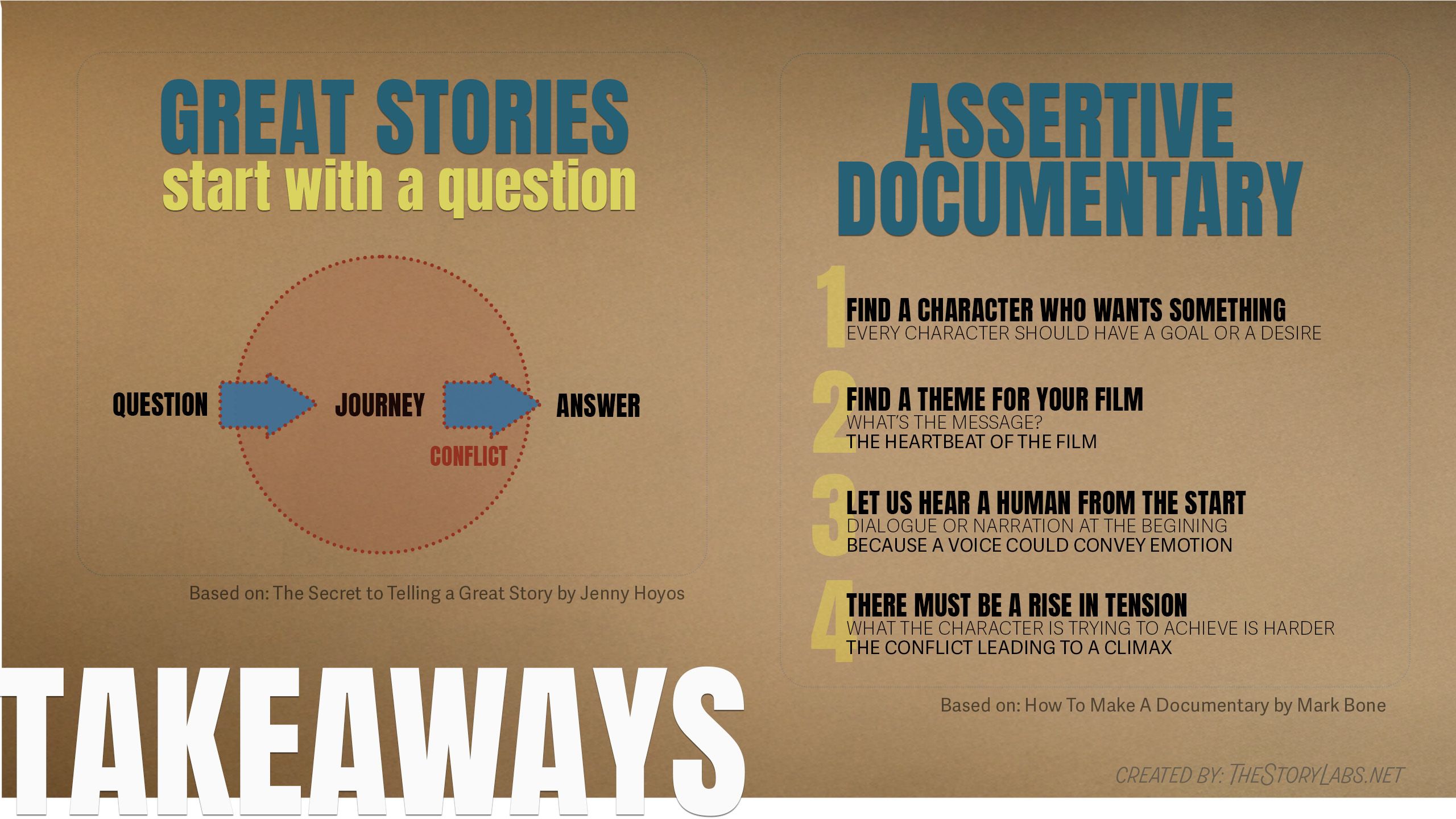
Great stories start with a question.
Question -> Journey (Obstacle) -> Answer
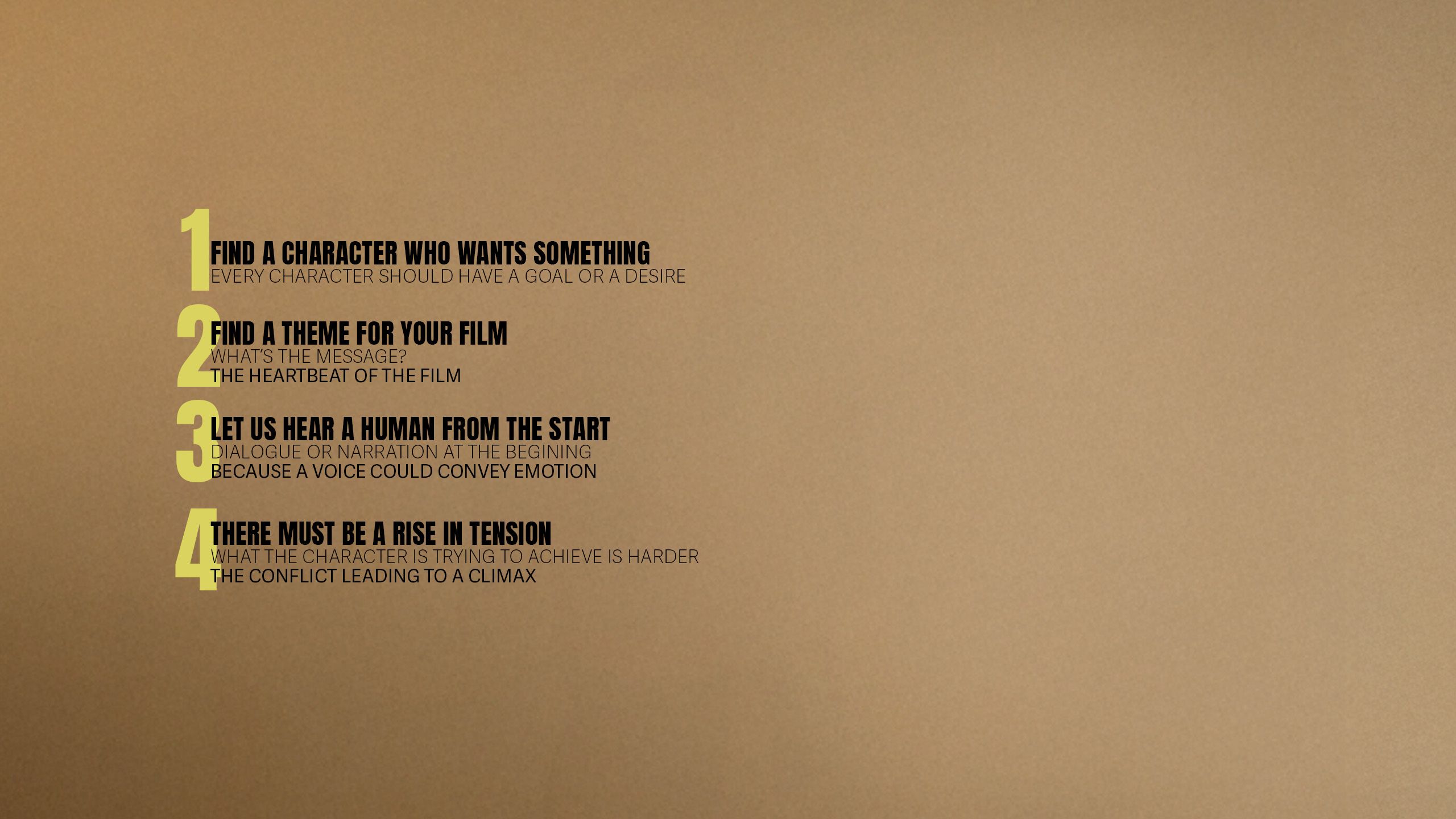
ASSERTIVE DOCUMENTARY
It Has a Clear Perspective
An assertive documentary is grounded in a distinct and unapologetic point of view. It embraces subjectivity and makes a claim about the world. The filmmaker doesn’t hide behind the camera; they engage with the topic directly, asserting what they believe is true or just. This clarity of voice gives the film its strength and direction.
It is Purpose-Driven
At its core, the assertive documentary exists for a reason. It aims to provoke thought, raise awareness, or push the audience toward a specific action or realization. Often focused on exposing injustice or highlighting silenced truths, this mode of storytelling is deeply connected to ethical purpose. It’s not just about informing viewers, it’s about moving them.
Has a Structured Argument
Rather than simply documenting events, this type of documentary builds a case. Through a combination of evidence, testimony, and interpretation, it leads the viewer through a logical sequence that supports its central thesis. Each element, from interview to image, is placed deliberately to reinforce the filmmaker’s argument and engage the viewer in critical thinking.


THE CHARACTER
Find a character with a goal and a challenge, and write a short paragraph about their journey (create a Word document).
- How do you create a character? Start from your experience, use your imagination.
- Identify three internal and external features of someone that you know (or yourself).
- Consider the world and the character. Recommendation: Use the What If? Statement. Check out this video as a guideline. See the following examples before creating your own characters.
Character Descriptions | Examples
- Simba struggles with guilt, fear, and the pressure of living up to his father’s legacy.
- Moana is torn between a sense of duty and a deep inner calling to explore and lead in her own way.
- Young feminists challenge inherited norms with clarity, courage, and conviction. They wrestle with tradition, question what has long been accepted, and expose the quiet harm hidden beneath polite customs. Their voices bring light to spaces shaped by discrimination, insisting on dignity, equity, and the right to be seen as they are.
The "WHAT IF" statement
The "What if" statement is a powerful storytelling tool that acts as a creative launchpad. It frames your story around a central imaginative premise, opening the door to narrative possibilities and helping define the world, conflict, and characters.
How to Use It: Ask:
- What if this truth were stretched or reversed?
- What if someone acted on an unspoken feeling?
- What if the central issue had to face its consequences?
Examples:
- What if water could speak—and it chose to tell the truth about us?
- What if no one in a town remembered how they used to live in balance with the land?
- What if silence around gender discrimination could no longer hold, and voices began to rise in unexpected places?
ISSUE AS THE CHARACTER
1. Personifying the Issue
You can give an issue human traits, motivations, or presence in the story. For example:
- What if this issue had a voice, intention, or pressure behind it? What is it pushing for? Example: Youth feminism needs recognition, voice, and systemic change.
- Injustice might be represented by a controlling entity or system that characters must confront.
This makes the issue active, it takes action, causes conflict, influences others.
2. The Issue as a Central Character (Symbolic)
Sometimes the issue is not personified but still functions as the main force in the story:
- The story revolves around how characters respond to it.
- It's what shapes the plot, even if it's never embodied.
3. Define the Issue’s Wants vs. Needs
Example:
Issue: Cultural silence around gender discrimination.
- Wants: To be left unchallenged; to maintain appearance of harmony; to avoid discomfort.
- Needs: To be acknowledged; to be questioned; to evolve toward justice.
Opposing Force (the response or counter-movement): Young feminists
- Want: To be heard, to protest, to reveal the truth.
- Need: To build solidarity, to reshape narratives, to create lasting structural change.
Issue - Character Descriptions | Examples
- Water scarcity looms with quiet urgency, shaped by decades of overuse, mismanagement, and climate extremes. It burdens communities with uncertainty, tests their resilience, and demands a reckoning with both nature and human responsibility.
- Misinformation spreads like wildfire, feeding on fear, confusion, and the human need for certainty. It disguises itself as truth, divides communities, and challenges the very idea of shared reality.
- Cultural silence around gender discrimination lives quietly in familiar spaces, cloaked in politeness and tradition. It wants to maintain peace, to avoid conflict, and to protect the image of unity. But beneath its stillness lies a deeper need—to be broken open, to listen to the voices it has long ignored, and to reckon with the harm it has allowed. It survives by asking others to stay quiet, but it begins to unravel the moment someone dares to speak.
Storytelling Tools You Can Use
- Metaphor: A desert might symbolize emotional or social drought.
- Archetype: The issue can act like a villain, trickster, or even a misunderstood guide.
- Structure: Let the issue drive the inciting incident, the rising conflict, or even the resolution.
Example
HOMEWORK: Character Description
Session 3:
Conflict or Tension as the Engine of the Story.
Themes:
- The relationship between character and world.
- Personal transformation through conflict.
- Belonging, identity, and inner motivation
In documentary filmmaking, as in fiction, conflict is what drives the narrative forward. It introduces movement, urgency, and emotional stakes. Without it, a documentary risks becoming a collection of disconnected facts or scenes rather than a compelling story.
While “conflict” is the standard term, alternative words like "obstacle" or “tension” can be useful, offering a softer, broader way to describe emotional or narrative pressure without implying confrontation.
- "The story unfolds through the tension between tradition and change."
Overview
Every great story starts when a character meets their world, and something changes. What if Simba never ran away? What if Moana never answered the call of the ocean? This week, you’ll explore how your own experiences can inspire a character, a world, and the turning point that sets everything in motion.
The turning point in Act One comes when a need or desire (or intention) is met with an obstacle, something that challenges the character’s comfort, beliefs, or direction. This moment introduces conflict and gives the story its drive. Your task is to imagine not just who your character is, but what stands in their way.
Guiding Questions:
- What personal experiences could inspire a story?
- The character meets the world – The beginning of the story.
Objectives:
By the end of this week, you will:
- Identify personal experiences that can inspire fictional or autobiographical stories.
- Understand how a character’s interaction with their world sets the story in motion.
- Use a simple story framework (Character – World – Obstacle – Resolution) to map your own story.
CHECK THIS OUT
Documentary Structure:
Act One, the setup, contains two key elements: introducing the world and establishing the character. As the act unfolds, the character’s needs or wants are revealed, and an obstacle emerges. This moment sets the story in motion, creating the tension that drives the narrative forward.
Conflict is the Engine of the Story
In documentary, as in fiction, conflict is what drives the narrative forward. It creates movement, urgency, and emotional stakes.
Conflict, obstacles, and challenges are tied directly to the story’s purpose, serving as tools to engage the audience and drive specific outcomes like educating, persuading, or inspiring action.
Inner Conflict
A character needs to confront problems within themselves that are preventing them from reaching their goals.
It provides shape to a multidimensional character. Many times, the inner conflict comes from the character's backstory. It is ideal for character-driven stories.
Self-Doubt
Moral Dilemma
Fear of Failure
Personal Conflict
Obstacles that are created by other characters.
The simplest version of this is the antagonist, a person opposed to the protagonist. Their goal is in direct contradiction with the main character.
Rivalry
Betrayal
Power Struggle
Extra-Personal Conflict
When conflict is larger than any one person.
It can be grouped into three main categories: Societal Conflict, Environmental Conflict, and Supernatural or Technological Conflict.
Injustice or Prejudice
Natural Disaster or a Survival Challenge
Unknown Forces or a Supernatural Threat
YOUR TASK
Story Map
Develop your story a step further. Take your character, and while using the videos for inspiration, map your story structure using this framework:
Character – World – Challenge – Resolution.
Examples:
Arts & Resistance
Character: A graffiti artist reclaiming public space through mural work
World: An urban neighborhood facing gentrification
Challenge: City policies restricting street art and displacement of longtime residents
Resolution: The artist collaborates with local organizations to turn murals into a platform for public memory and action
Environmental Justice
Character: A group of youth water protectors
World: A region where sewage threatens the once-pristine rivers central to their neighborhood.
Challenge: Legal battles, media silence, cultural erasure, and a community, along with local officials, that has turned its back on the rivers.
Resolution: Their story gains national attention after they engage other schools and youth. Through education, art and collective action, they inspire broader solidarity and begin to restore both awareness and care for the waters they’ve long protected.
Some documentaries center around invisible or normalized conflicts, like silence, cultural pressure, or internal dilemmas. Naming and framing these as conflict allows filmmakers to illuminate what’s hidden.
HOMEWORK: STORY MAP
Add your title
Combine large, bold images with the beautifully crafted words of your story.


 Built with Shorthand